
13 Best Waterfalls in Iceland: Must-See Falls & How to Visit
Whether you are planning on only driving the ring road or venturing into the Icelandic highlands, here we go over must-see waterfalls in Iceland.
Did you know the World of Waterfall's top 10 list includes 2 Icelandic waterfalls? They are Gullfoss and Dettifoss, which we go over in this blog today. Iceland is full of water in all forms: frozen, boiling, swimming pools, and more. Iceland has over 100 waterfalls, and new ones form each year.
|
1. Hraunfossar 2. Svartifoss 3. Goðafoss 4. Gullfoss 5. Seljalandsfoss 6. Glymur 7. Hengifoss |
8. Dettifoss 9. Dynjandi 10. Ófærufoss 11. Brúarfoss 12. Gufufoss 13. Aldeyjarfoss |
Hraunfossar
First on our list is the beautiful Hraunfossar. This isn't just one waterfall, but many flowing through cracks in the lava field. Not far from Hraunfossar, you will also find the beautiful Barnafoss (Children's Waterfall). Located only a 1-minute walk from Hraunfossar, both are easily accessible from the parking lot.
How to visit Hraunfossar? When this blog was written, there were no tours you could join to get to Hraunfossar, so you had to rent a car to get there. The drive to Hraunfossar takes about 1 hour and 45 minutes. You take Route 1 north until you see the town of Borgarnes. Just before you cross the bridge, turn right onto Route 50. When Route 50 turns left, you will head straight onto Road 518, which leads to the Hraunfossar parking lot on the left. You will have to pay a small parking fee. If you continue on Route 518, you will reach Húsafell, where you can find a lovely hotel for the night, a campsite, and a swimming pool.
Svartifoss
Located in southeast Iceland, Svartifoss (Black Waterfall) is in Skaftafell, Vatnajökull National Park. The waterfall got its name from the dramatic contrast between the white water and the surrounding dark basalt columns. This waterfall inspired the architecture of Hallgrímskirkja church in Reykjavík.
To get to Svartifoss waterfall, you will need to take a 1,5 km hike from the visitor centre. This hike is uphill, and you will see a few other waterfalls on the way. The hike takes approximately 90 minutes going back and forth
You can then spend the night at the nearby camping ground in Skaftafell; for that, we recommend checking out our campers.
How to visit Svartifoss?: There is approximately a 4-hour drive to Svartifoss from the Capital if you have a rental car. You'll stop at the visitor centre in Skaftafell, where you can get information and tips about the area before you start your journey.
Goðafoss
Is located in the north of Iceland in the river Skjálfandafljót. It has a 12-meter (39-foot) drop, and its width is 30 meters (98 feet). The waterfall got its name, Goðafoss (Which translates to the waterfall of the Nordic gods), because the first settlers who arrived in Iceland in the 9th and 10th centuries followed the old Norse religion. However, when the commonwealth was established in 930 AD, Icelanders began being pressured to convert to Christianity. People believed Norway would invade Iceland if Icelanders continued to hold to their pagan beliefs. This issue was therefore discussed at Þingvellir, where the parliament met once a year, and the Asatru priest Þorgeir Ljósvetningagoði was given responsibility for the decision.
He concluded that Icelanders would adopt Christianity, but pagans could practice privately.
To symbolise his decision, he returned home and threw idols of the old gods into a beautiful waterfall; since then, it has been known as Goðafoss.
How to visit Goðafoss?: Goðafoss waterfall, as mentioned above, is in northern Iceland. The drive from Reykjavík takes approximately 5 hours, but it is only a 30-40 minute drive from Akureyri. You can find tours that will take you there; however, it is also very easy to go there yourself in a rental car. Take Route 1 through Akureyri (heading to Mývatn), and when you reach the N1 gas station in the small „town“ of Fosshóll, take a right onto road 844. There you will find the Goðafoss waterfall parking lot.
Gullfoss
Probably Iceland's most famous waterfall, of course, needs to be on this list. Gullfoss means the Golden Waterfall and is part of the Golden Circle, which includes Gullfoss, the Geysir Geothermal Area, and Þingvellir National Park.
Gullfoss has a two-tier drop of 32 meters (105 ft), and in good weather, you can walk close enough to feel the water spray on your face. However, if the stop signs are up, please do not go too close.
How to visit Gullfoss?: You can either visit Gullfoss by tour or rental car. Plenty of tours cover the Golden Circle, so finding one should be easy. If you decide to rent a car, it's easy to get there, and it's not too far from the capital area. You will find two parking lots there, and visiting the waterfall is free.
Seljalandsfoss
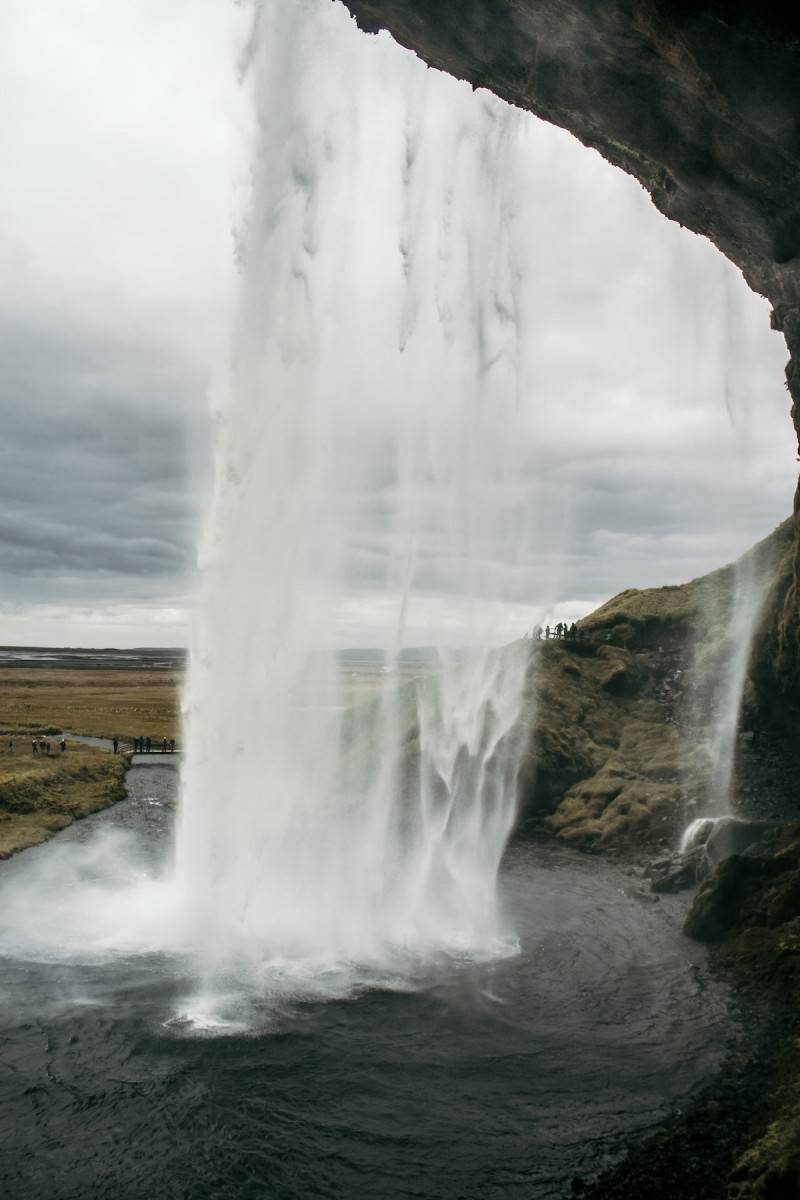
The other widely known waterfall. Located just off the ring road, you can even see it from there; however, we recommend stopping to walk behind it, as that's the real wow factor of visiting Seljalandsfoss waterfall. It is a narrow waterfall with a drop of 60 meters (197 ft), and we recommend bringing waterproof clothing for the walk behind it. The path may be slippery, and the waterfall creates a lot of spray and mist, so you'll likely come back wet.
Seljalandsfoss waterfall is part of the river Seljalandsá, which originates in the glacier Eyjafjallajökull. You might have heard of the glacier as it is the one that erupted and stopped all air traffic in Europe in 2010.
How to visit Seljalandsfoss?: Seljalandsfoss is just off Route 1 on Iceland's south coast. You can actually see it from the ring road. You can find south coast tours that will take you there, and it's also easy to get there in a rental car; you won't need a 4x4 for the drive. The drive to Seljalandsfoss is approximately 2 hours from the capital area
Glymur
Definitely one of Iceland's most beautiful waterfalls. It was ranked as Iceland's highest waterfall, standing at 198 meters (650 feet) until 2011, when Mosárfoss in Vatnajökull National Park was discovered. As we said before, new waterfalls form each year in Iceland, and Glymur is now the second-highest waterfall in Iceland.
To reach Glymur, you'll have to take a one-and-a-half-hour hike from the parking lot. The hike is mostly through nature, and none of it is paved. You will have to wade through a river, walk through a cave, and walk along a narrow mountainside path. So we recommend taking the hike only if you are in reasonably good shape and bring water, snacks, and warm clothes. The route is marked and is easy to follow; however, there are some off-trail sections, so just follow the signs that lead you to the waterfall.
How to visit Glymur?: Glymur is situated at the rear end of the fjord Hvalfjörður, so it is only a 45-minute drive from the capital area. Take Route 1 north, then just before you reach the Hvalfjarðagöng tunnel, turn right onto Route 47. That route takes you along the fjord until you reach a parking lot labelled Botnsá at the bottom of the fjord. You can catch a bus tour from Reykjavík to Glymur, and it is also an easy drive with a rental car.
Hengifoss
Is located in the east of Iceland and is 700 km from Reykjavík. Hengifoss translates to „the hanging waterfall“ and is the 3rd highest waterfall in Iceland and has fallen off 128 meters from the plateau into the magnificent gorge. The rock face surrounding the waterfall is colorful showing off different layers from volcanic eruptions over the centuries. The hike from the parking lot is a 40-60 minute gradual climb uphill (2,5 km). The trail is a bit difficult, but benches line the trail so you can stop and rest if needed. Along the way, you will see another amazing waterfall called Litlanesfoss waterfall, as well as Stuðlabergsfoss waterfall. Stuðlabergsfoss means „basalt column waterfall“ and is rightfully so, as it is framed by them.
How to visit Hengifoss?: The drive from Reykjavík to Hraunfossar is approximately 8 hours without any stops. So we don't recommend doing it in one day. We recommend making stops along the way and maybe staying the night in or around Egilsstaðir. There are a number of hotels, guesthouses, and campsites in the area where you can stay. The drive from Egilsstaðir to Hengifoss is about 30 minutes via Road 95 and Road 931.
Dettifoss
Dettifoss is a waterfall in northern Iceland. It is part of the Diamond Circle, and we highly recommend stopping at Dettifoss if you are in the region. It is one of the most powerful waterfalls in Europe, 100 meters (330 feet) wide, with a 45-meter (150 feet) drop into Jökulsárgljúfur canyon. It is a part of Vatnajökull National Park and therefore Dettifoss is very well protected. Dettifoss is so powerful and large that you can see its mist from several miles away.
Dettifoss is fed by the magnificent Jökulsá á fjöllum river; however, it is not the only waterfall fed by this river. There are 2 other waterfalls no less impressive than Dettifoss: Selfoss (not the town) and Hafragilsfoss.
How to visit Dettifoss? The drive to Dettifoss from Reykjavík is almost 6 hours, so we recommend making a few stops on the way. For example, the drive from Akureyri is only 2 hours. You can visit Dettifoss from 2 sides: the east or west. Both are gravel roads, but you don't need a 4x4. Just be careful, as they do have some rough spots and potholes. The parking lots on each side are small and fit only 25-30 cars, so we recommend heading there early, as they are often full around noon.
Dynjandi
Dynjandi is in Iceland's Westfjords and is nothing short of magnificent! Dynjandi is often said to look like a bridal veil, starting narrower at the top and widening to 60 meters at the bottom.
Six other waterfalls lie below Dynjandi. Their names are Hæstahjallafoss, Strompgljúfrafoss, göngumannafoss, Hrísvaðsfoss-Kvíslarfoss, Hundafoss and Bæjarfoss.
There is a little hike to reach Dynjandi waterfall; however, it is only approximately 15 minutes, and you will see a few smaller waterfalls on the way. You do have to climb a little to get all the way up to Dynjandi. It is not much of a climb, but if you have bad knees, for example, it may not be ideal.
Photos of Dynjandi don't do it justice, as it looks much smaller than it actually is. As well as the amazing bright red colours on the rocks that can be found in and around the waterfall. The red colour comes from ancient layers of soil stuck between the lava beds, which are rich in iron.
How to visit Dynjandi?: When planning on visiting the Westfjords, the best option is to rent your own vehicle. However, you can also take a bus or a super jeep tour with an experienced guide. Dynjandi is a 5-hour drive from Reykjavík. If you are travelling with a camper, a great camping site nearby lets you stay the night before continuing your journey. You can even fall asleep to the sound of the Dynjandi waterfall.
Ófærufoss
Ófærufoss waterfall is located in the western part of Vatnajökull National Park. It is only accessible from mid-June until late September, as the highland roads are closed over the winter months for protection.
The waterfall's surroundings are so magnificent that you can easily spend up to 3 hours there. The waterfall itself is no less impressive, falling in two cascades into Eldgjá canyon from the river Nyrðri-Ófæra. Once, a natural stone arch spanned the lower part of the waterfall; however, it collapsed in 1993 as it fell into the river during the spring thaw.
How to visit Ófærufoss?: You can get there by bus tour to Landmannalaugar, so you don't have to drive yourself. The only downside is that the bus only stops at Ófærufoss waterfall for an hour; if you want to hike up to the waterfall, that is definitely not enough time to explore the area. If you have a rental car, you'll need a 4x4, as you will be driving on F-roads and crossing a river. Be sure to assess the river's depth before crossing.
The drive from Reykjavík to Ófærufoss waterfall is approximately 4-5 hours, depending on weather conditions that may slow you down.

Brúarfoss
Brúarfoss is often known as „The blue waterfall“. The beautiful blue water in Brúarfoss comes from the Brúará river, which is fed by glacier melt from the Langijökull glacier. It may not be one of Iceland's biggest waterfalls, with only a 2-3 meter drop; however, it might be one of the most beautiful ones, so we just had to include it on this list! It is located on the west side of Iceland and is only a 1.5-hour drive from Reykjavík. Brúarfoss means „Bridge Waterfall“, and it gets its name from the stone arch that once stood over it like a bridge for those who wanted to cross it.
Getting to Brúarfoss waterfall today is not the same as it was a few years ago. Once you could park relatively close by with a walkover private property. However, visitors trampled the fragile plant life and left behind trash and even human waste, so they closed the trail to the public to protect nature. Today, the hike to Brúarfoss takes 2-3 hours and is a 7 km (4.4 miles) round trip.
How to visit Brúarfoss waterfall? The waterfall is only a 20-minute drive from Gullfoss, making it the perfect stop on your way around the Golden Circle, for example. There is a 7 km (4.4 mile) flat walk to and from Brúarfoss, and it will take between 2-3 hours.
Gufufoss
If you intend to visit the small town of Seyðisfjörður, then you will stumble upon this beautiful waterfall. Located right by the road leading up to the small town. It is smaller than many waterfalls in Iceland but absolutely gorgeous. Gufufoss translates to „Steam waterfall“ and is rightly so. Although smaller than most, Gufufoss is very powerful for its size, and due to that power, there is a lot of mist that often looks like steam, hence the name.
How to visit Gufufoss?: As said before, Gufufoss is located just outside the road to the town of Seyðisfjörður. More exactly, road 93. The drive from Reykjavík to Seyðisfjörður takes about 8 to 9 hours. If you plan to drive the east coast, we recommend stopping in the beautiful town of Seyðisfjörður and checking out the waterfall along the way.
Aldeyjarfoss
Aldeyjarfoss is located in northern Iceland. It drops 20 meters into a beautiful blue lagoon and is surrounded by basalt columns from the Báðardalshraun lava field above. Like Goðafoss, this waterfall is also fed by the powerful Skjálfandafljót river; however, Aldeyjarfoss is harder to reach but well worth it! You can even drive almost all the way to the waterfall in a 4x4.
How to visit Aldeyjarfoss? The waterfall is located in the Icelandic highlands, so you'll need a 4x4 rental for the journey, as you will have to take some F-roads. The drive from Akureyri is about 1.5 hours, taking the ring road until you reach road 842. Then continue on that road until you take a turn onto road F26, which takes you almost all the way up to the waterfall.
